
Instructional design has always been shaped partly by the cost of getting a decision wrong. When production is expensive, there is a strong incentive to resolve, approve and lock down as much as possible before development begins. But as AI-assisted authoring, reusable components and more capable development tools reduce the effort required to produce and revise learning artefacts, that constraint begins to weaken. The interesting question is not simply how much faster we can produce learning, but what changes when some design decisions no longer need to become final quite so early.
Introduction
A recent project showed us how much instructional design workflows can be shaped by the cost of change.
A late content update required whole modules to be reworked. Voice-over sections had to be recorded again. Design changes meant rebuilding slides. The review and approval gates had reduced the likelihood of that rework, but they could not remove it. Once change was still required, the cost was significant.
That logic is understandable. When development is expensive, there is a strong incentive to resolve and approve as much as possible before substantial production begins.
The tools used to produce learning are making some of that work easier to change. AI-assisted authoring, easier media production, reusable components and increasingly capable development tools are reducing the effort required to produce and revise many learning artefacts. Work that once meant rebuilding screens, re-recording audio or sending substantial changes back through a production process can, in some cases, now be changed much more quickly.
This does not make learning production free or remove the other constraints surrounding instructional design. But it does begin to weaken one of them.
So what happens to the workflow when the cost of being wrong after production has started begins to fall?
The practices are not new, the constraint may be changing
None of the practices this opens up are particularly new.
Performance analysis has long asked practitioners to understand the performance problem before deciding that learning is the answer. Formative evaluation established the value of testing and revising an intervention while it is still being developed. SAM made successive approximation, prototyping and repeated evaluation explicit within instructional design, while LLAMA adapted agile ways of working to learning-development projects. Human-centred design similarly emphasises users, tasks and the context in which something will actually be used.
Even ADDIE does not require a strictly linear process. Its broad phases can accommodate iteration and movement back to earlier decisions.
Cheaper production has not suddenly made instructional design iterative, and it does not create a reason to replace ADDIE with SAM or another methodology.
What may be changing is one practical constraint on how easily those established practices can be used.
Production cost is only part of that constraint. Governance, access to subject-matter experts and employees, procurement, operational risk and the availability of useful evidence can all limit how iterative a project can become. Making an artefact cheaper to produce does not make those constraints disappear.
But it can reduce the penalty for revisiting a design decision after something has already been made. That may allow some lower-risk, reversible decisions to remain open long enough to be tested rather than fixed mainly because changing them later would be expensive.
To see where that flexibility might matter, it helps to make the decision points and feedback loops more visible.
Using the nine activities as a lens
One way to do that is to separate the work into a set of activities:
Decompose → Decide → Prototype → Test → Revise → Contextualise → Deploy → Observe → Improve
The sequence is shown linearly for readability, but it is not intended to operate as nine consecutive stages. It is a synthesis of activities already present across performance analysis, iterative design, formative evaluation, agile practice and human-centred design. It can sit within ADDIE, SAM or another approach.
Its value here is that it makes the relationships between decisions, evidence and possible reversal more visible.
For each activity, four questions are useful:
- What decision is being made?
- What evidence can inform or challenge it?
- How provisional can that decision safely remain?
- What constrains iteration?
Evidence does not always move the work forward. Testing may show that the treatment choice was wrong. Contextualisation may expose an assumption that does not hold in practice. Observation after deployment may reveal that the original performance problem was misunderstood.
The synthesis is therefore less useful as a sequence than as a way of seeing the loops that connect the work, and why evidence may send the process back rather than onwards.
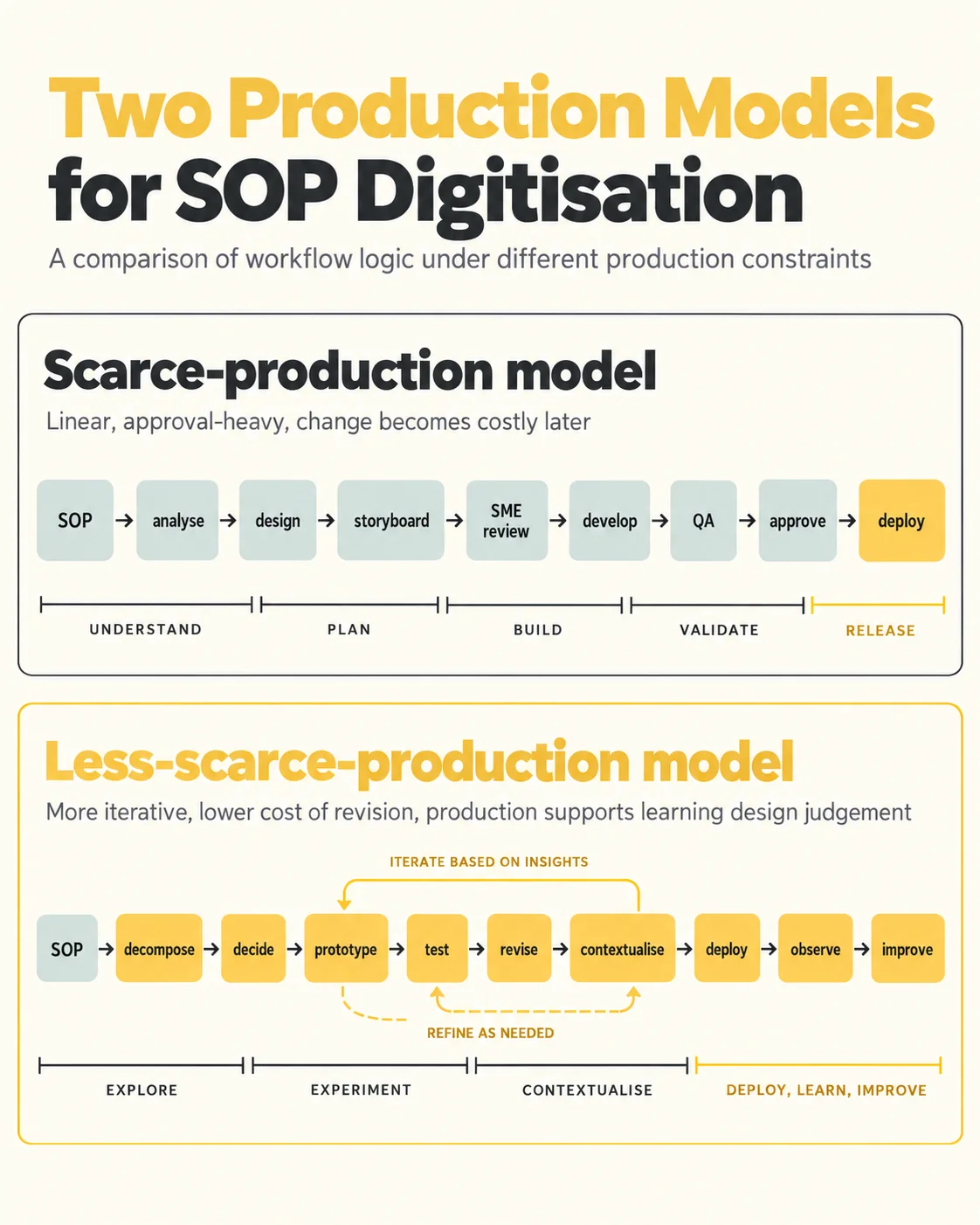
Before producing: Decompose and Decide
Before producing anything, the first task is to separate the requirement from the document that contains it.
An SOP may combine very different needs: something an employee must remember, a sequence they must follow, a judgement they need to make, information they only need to reference, a standard they must demonstrate, or an acknowledgement that needs to be recorded. Treating all of that as one learning requirement can lead quickly to “document becomes course”.
Decomposition is therefore a working diagnosis. The SOP provides evidence, but it may not reflect how the work actually happens. SME input, observation, employee experience, recurring errors and performance data can all challenge the initial interpretation. The aim is to understand the requirement well enough to move forward without assuming that the first reading must remain fixed.
Only then does the next decision become useful: what response, if any, does each requirement warrant?
Learning is one option. Others may include performance support, reference material, workflow guidance, assessment, practical verification or even a process change. A safety-critical standard may need early certainty, while the choice between a checklist, scenario or other treatment may remain open long enough to test.
Less-scarce production does not remove the need for judgement at this point. It gives that judgement more room to remain provisional where the decision is reversible and evidence can improve it.
The core iterative loop: Prototype, Test and Revise
Once a treatment has been chosen, the next step is to make enough of it real to test the thinking behind it.
That is the role of the prototype. It does not need to resemble a nearly finished product. Its value lies in answering a design question. Can employees make the intended decision? Does the sequence make sense in practice? Is the proposed support usable while the task is being performed?
This is where lower production costs can matter most. If creating and discarding a prototype is relatively inexpensive, the threshold for testing an idea becomes lower. The prototype shifts from being a preview of the final product towards becoming an instrument for enquiry.
Testing asks whether the assumptions embodied in that prototype hold up. The evidence may be quantitative or qualitative. It might come from observation, task behaviour, employee interpretation, usability problems, SME validation or the decisions people make in a scenario. What matters is not the volume of evidence, but whether it is appropriate to the decision being tested.
Cheaper prototypes do not make testing cheap. Access to employees, SME time, operational realism and safety can still be the real constraints. Testing is most useful while there is still practical freedom to respond to what is learned.
Revision is where that evidence has to be interpreted. Not every comment should trigger a change. The question is what the evidence actually justifies.
Sometimes the answer is a small adjustment to the artefact. Sometimes it points to a different treatment. In other cases, it may challenge the original decomposition or intervention decision.
This is where lower revision costs become significant. They reduce the penalty for admitting that an earlier decision may have been wrong.
The value of iteration, then, is not that it produces more versions. It is that evidence can inform judgement while there is still room to change direction.
Moving towards real work: Contextualise and Deploy
A treatment that works in a controlled test can still fail when it meets the conditions of actual work.
Contextualisation is a deliberate re-test of whether the intervention still makes sense in that environment. Context should already have influenced Decompose, Decide, Prototype and Test. Its position here does not mean it is being introduced for the first time.
What becomes explicit at this point is fit with the conditions of use: devices, connectivity, language, workflow, time pressure, operating conditions and organisational constraints.
Sometimes that may lead to a relatively small adaptation. In other cases, it may challenge the treatment itself.
Contextualisation is also broader than localisation. A resource can be translated, branded and technically accessible, yet still be poorly suited to the task or environment in which it is meant to support performance.
Deployment then moves the intervention into real operational use. It is more than publication.
Where risk allows it, deployment can be incremental: one team, one site, one procedure or one user group. The scale should reflect the confidence available and the consequence of failure.
That does not mean putting unfinished or unverified interventions into the workplace and seeing what happens. Safety, compliance, standardisation or operational urgency may require stronger controls and broader formal release.
Deployment does, however, provide access to a different kind of evidence: how the intervention behaves when it becomes part of normal work rather than how it performs in a test.
After launch: Observe and Improve
Deployment should not automatically mark the end of instructional-design reasoning.
Once an intervention is in use, observation helps establish what actually happens in practice. Usage data, task errors, supervisor observations, support requests, employee feedback and operational measures can all be useful, but they answer different questions.
Monitoring can tell us that something was completed, accessed or used. It does not necessarily explain whether the intervention is helping, where people are struggling or why performance looks the way it does. Operational evidence still requires interpretation because performance rarely has a single cause.
Improvement begins with that interpretation. The question is whether the evidence justifies change and how far that change should reach.
When revision is easier, smaller and more targeted improvements become more practical. A scenario can be adjusted, a job aid simplified or a workflow changed without waiting for enough problems to accumulate to justify a full redevelopment project. In other cases, the evidence may suggest replacing or retiring the intervention altogether.
That does not mean continuous change. Frequent revision can create version-control problems, instability and change fatigue. A mature intervention may need no change at all if the evidence suggests it is still doing its job.
Where change is justified, the evidence may send the process back to Contextualise, Revise, Decide or even Decompose. Deployment therefore extends the feedback loop rather than closing it.
What less-scarce production actually changes
Instructional designers already have well-established ways to work iteratively. The more useful question here is: when does a particular decision genuinely need to become fixed?
For some decisions, the answer will still be early. Safety, compliance, accuracy or operational consequence may require certainty before the work can move forward.
For others, there may be value in keeping the decision open long enough to test the assumption, gather evidence and adjust course.
Less-scarce production does not remove governance, judgement, risk or the cost of gathering useful evidence. What it can change is the cost of revisiting a decision once something has already been made.
The opportunity is greater reversibility where that improves the quality of the decision, with commitment driven by evidence, consequence and risk rather than mainly by the cost of changing the artefact later.
References
-
Allen Interactions. (n.d.). The Successive Approximation Model (SAM). https://www.alleninteractions.com/expertise/process/
-
Allen, M. W., & Sites, R. (2012). Leaving ADDIE for SAM: An agile model for developing the best learning experiences. ASTD Press.
-
Association for Talent Development. (n.d.). The ADDIE model. ATD. https://www.td.org/templates-and-tools/the-addie-model
-
Beck, K., et al. (2001). Manifesto for Agile Software Development. Agile Manifesto. https://agilemanifesto.org/
-
International Organization for Standardization. (2019). ISO 9241-210:2019 Ergonomics of human-system interaction — Part 210: Human-centred design for interactive systems (2nd ed.). ISO.
-
International Society for Performance Improvement. (n.d.). Accreditation standards. International Society for Performance Improvement.
-
Molenda, M. (2003). In search of the elusive ADDIE model. Performance Improvement, 42(5), 34–36. https://doi.org/10.1002/pfi.4930420508
-
Tessmer, M. (1993). Planning and conducting formative evaluations: Improving the quality of education and training. Kogan Page.
-
Torrance, M. (2019). Agile for instructional designers: Iterative project management to achieve results (LLAMA). ATD Press.

