
In the first article in this series, we argued that capability should be viewed as a value chain rather than a collection of disconnected learning activities. In the second, we explored how learning, skills, capability, performance, and business outcomes each create different forms of value, and why confusing them leads to weak measurement and unclear impact. This article takes the next step. If capability develops through value chain logic, then evidence should too.
The challenge is not a lack of data. Most organisations can measure learning activity in extraordinary detail. The challenge is proving that capability has actually improved. To do that, organisations need to rethink where evidence is created, how it flows through the capability system, and what genuinely demonstrates contribution beyond learning itself.
If We Can Measure More Than Ever, Why Is Capability Still So Hard to Prove?
Most Learning and Development teams have more data than ever before. Learning platforms can report completions, pathway engagement, certifications, skill profiles, AI-generated recommendations, and a growing range of workforce insights. On the surface, that feels like real progress. For many organisations, the long-standing visibility problem appears to be getting smaller.
Yet capability remains surprisingly difficult to prove.
An organisation may report 95% programme completion, high assessment scores, and verified skills across a target population. Those metrics suggest progress and provide confidence that learning is taking place. But when leaders ask whether managers are coaching more effectively, whether onboarding has become faster, or whether customer issues are being resolved more consistently, the answers are often far less clear. Learning activity is visible. Evidence that capability has improved is often much harder to find.
That tension sits at the heart of the challenge. As learning and skills data become richer, many organisations assume capability is becoming easier to measure. The assumption is understandable because visibility has improved dramatically. However, visibility into learning is not the same as visibility into performance. Learning systems are designed to capture participation, progression, and signals of skill development. They are far less effective at observing what happens when people return to work and attempt to apply those capabilities in real operating conditions.
For organisations focused on capability-building and performance improvement, this distinction matters. If capability develops through a value-chain-like logic that connects learning, skills, performance, and business outcomes, evidence needs to exist across that chain as well. Yet many organisations still try to prove capability after learning has happened rather than designing evidence into the system from the start.
That is the shift this article explores.
If Capability Happens in Work, Why Are We Still Looking for Proof in Learning Systems?
One reason capability remains difficult to prove is that many organisations look for evidence in the same place they deliver learning. The instinct is understandable. Learning platforms are often the richest source of development data available, making it tempting to treat learning evidence as capability evidence. Yet the two serve very different purposes.
Learning systems are designed to answer questions about activity. Who completed the programme? Who passed the assessment? Which skills were verified? These are useful signals because they help organisations understand participation, progress, and engagement. They provide evidence that learning has taken place. What they do not automatically provide is evidence that behaviour has changed or that performance is improving in the workplace.
Capability develops under very different conditions. It emerges when people apply what they have learned, adapt it to their environment, make decisions under pressure, and perform consistently over time. Those moments rarely occur inside an LMS. They occur in customer conversations, coaching discussions, project meetings, operational reviews, and countless other situations where work is actually being done.
The difference becomes important when organisations begin making assumptions about performance. A leadership programme may achieve strong completion rates, positive feedback, and verified leadership skills. Six months later, coaching quality may remain unchanged, delegation may still be inconsistent, and escalation dependency may persist. Learning occurred. Whether capability improved is far less certain.
The underlying issue is straightforward. Learning and capability are not observed in the same place. Learning systems remain important because they show what people have been exposed to and what skills they may have developed. Capability only becomes visible when those skills are applied in practice. If organisations want to understand whether capability is influencing performance, they need to look beyond the platform and into the workplace itself.
If Capability Follows a Value Chain, Why Isn’t Evidence Designed the Same Way?
In the previous article, we explored the idea that capability development can be viewed through a value chain lens. Learning contributes to skills. Skills mature into capability through application. Capability influences performance, and performance can contribute to business outcomes over time. If value is created through a sequence of connected stages, it follows that evidence should move through those stages as well.
Yet many organisations treat evidence differently. Learning is designed upfront, while measurement is often left until later. A programme is launched, participation is tracked, assessments are completed, and only then does the organisation begin asking whether capability improved. The problem is that if evidence was never designed into the process, proving capability afterwards becomes much harder.
A more effective approach is to build evidence into the capability system from the beginning. Rather than starting with learning and hoping to demonstrate impact later, organisations start with the outcome they want to influence and work backwards through the conditions required to achieve it. Measurement shifts from a reporting exercise to a design discipline.
This creates what we refer to as the Capability Evidence Loop:
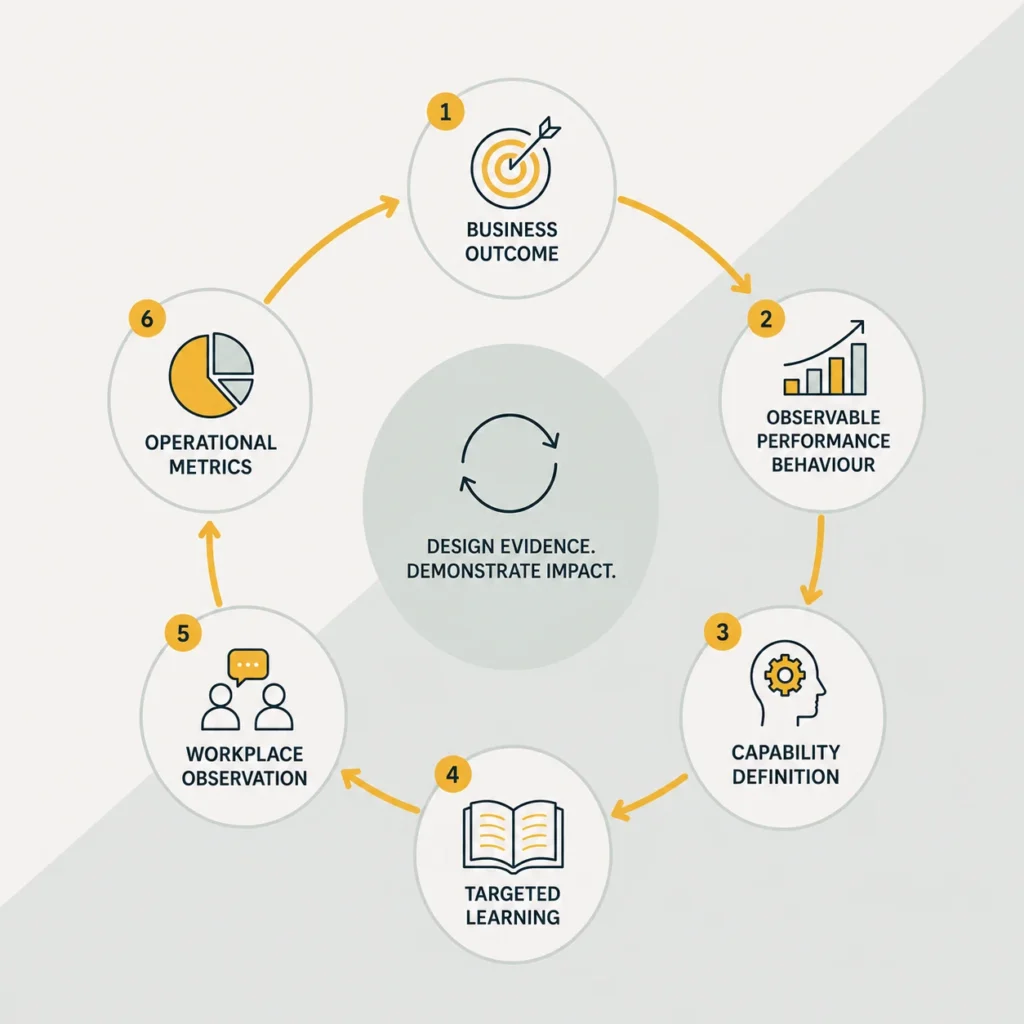
The fact that the loop begins and ends with a business outcome is deliberate. Capability-building initiatives are often designed from the learning inward, with success judged primarily by participation, completion, or skill acquisition. The Capability Evidence Loop takes the opposite approach. It starts by identifying the business outcome the organisation is trying to influence and then works backwards to define the behaviours, capabilities, and learning required to support that outcome. It then follows the chain forward again, using workplace observation and operational measures to determine whether those capabilities are translating into improved performance and, ultimately, contributing to the original business objective. By anchoring both ends of the loop to a business outcome, organisations maintain a clear line of sight between capability development activity and the value it is intended to create.
Each stage informs the next. Desired business outcomes help define the behaviours that need to change. Those behaviours clarify the capabilities people must demonstrate. Learning is then designed to support those capabilities. Once learning occurs, workplace observation and operational metrics provide evidence of whether capability is strengthening and whether performance is moving in the intended direction.
The key shift is that evidence is no longer something collected at the end of a programme. It becomes part of the programme architecture itself. When leaders ask whether capability is improving, the organisation is not scrambling to find proof after the intervention. It has already identified where evidence will emerge, who will observe it, and how it will be validated.
Capability evidence is evidence that people are applying skills in ways that influence workplace performance.
Why Do So Many Programmes Look Successful While Performance Remains Unclear?
When evidence is treated as a reporting activity rather than a design activity, it becomes surprisingly easy to mistake activity for contribution. This pattern appears repeatedly in capability-building initiatives. Learning data looks strong, engagement appears healthy, and skills signals suggest progress. Yet the relationship between those indicators and actual workplace performance often remains uncertain.
Part of the challenge is that learning evidence is relatively easy to collect. Completions, certifications, assessments, and skill profiles are readily available within learning systems. Performance evidence is different. It requires organisations to examine behaviour, execution, decision-making, and outcomes in the flow of work. That evidence is often spread across managers, operational systems, customer interactions, and business metrics rather than sitting neatly inside a learning platform.
The result is a common blind spot. A sales enablement initiative may achieve 100% certification rates, strong assessment results, and updated skill profiles across the sales team. Viewed through a learning lens, the programme appears successful. Ninety days later, the sales cycle may remain unchanged, conversion rates may still be flat, and discounting behaviour may continue exactly as before. The organisation has clear evidence that people completed the learning. It has much weaker evidence that capability improved or that performance changed.
The same pattern appears across leadership development, customer service, technical training, and many other capability-building initiatives. Positive learning signals create confidence because they are visible and easy to report. Visibility, however, should not be confused with contribution. A programme can generate strong evidence at the learning and skills stages of the value chain while leaving capability, performance, and business outcomes largely unverified.
This is where organisations often overestimate success. The critical question is no longer whether people completed the learning. It is whether learning changed how work gets done. If evidence breaks before that question can be answered, capability remains assumed rather than demonstrated.
A sales enablement initiative illustrates the point. The programme may achieve 100% certification rates, strong assessment results, and updated skill profiles across the sales team. On paper, the evidence looks compelling. Yet 90 days later, the sales cycle may remain unchanged and conversion rates may show little or no improvement. In that situation, the organisation has clear evidence that learning occurred, but far less evidence that capability strengthened in ways that influenced performance.
When Does Capability Become Visible?
If learning evidence is not enough, what does credible capability evidence actually look like?
The answer sits between learning activity and business impact. Capability becomes credible when it can be observed influencing behaviour in ways that matter to performance. This distinction is important because organisations often jump directly from learning metrics to business outcomes, expecting one to prove the other. In reality, capability forms the bridge between the two.
Consider a newly trained manager. Immediately after a programme, the organisation may be able to report completion, assessment scores, and skill verification. Those indicators suggest the manager has learned something. What they do not show is whether those capabilities are being applied consistently in the workplace. The first meaningful evidence appears when coaching conversations improve, feedback becomes more consistent, delegation becomes more effective, or team members begin solving problems with less escalation.
These behavioural changes matter because they provide an observable signal that capability is influencing execution. They do not yet prove business impact, but they show that learning is beginning to affect how work gets done. Over time, stronger coaching may contribute to improved engagement, reduced turnover, or better team performance. The important point is that capability becomes visible before business outcomes fully emerge.
This creates a useful way of thinking about evidence maturity. Activity evidence tells us what people did. Capability evidence tells us how behaviour is changing. Performance evidence shows whether execution is improving. Business impact demonstrates whether those improvements are contributing to organisational outcomes.
Recognising these distinctions helps organisations avoid unrealistic expectations. Business outcomes often take time to emerge and are influenced by factors beyond a single intervention. Capability evidence appears much earlier. It provides a practical indication that progress is being made and helps organisations understand whether they are moving in the right direction before larger outcome measures become visible.
Capability becomes credible when organisations can move beyond participation data and point to observable changes in how work is being performed. That is often the point at which learning begins to demonstrate meaningful contribution.
Are Managers Supporting Transfer, or Are They the Transfer Mechanism?
Many discussions about learning transfer position managers as a supporting factor. Managers are encouraged to reinforce learning, create opportunities for practice, and hold follow-up conversations after a programme. These activities are important, but they do not fully capture the role managers play in capability development.
If capability emerges in the flow of work, someone needs to observe whether that capability is actually appearing. In most organisations, managers occupy that position. They are close enough to the work to see whether behaviour is changing, whether judgement is improving, and whether performance is becoming more consistent. As a result, managers often become the first source of meaningful capability evidence.
Viewed through the Capability Evidence Loop, this role becomes even more significant. Learning may introduce new knowledge and skills, but workplace observation helps validate whether those capabilities are being applied. Without observation, organisations are left relying largely on assumptions. They know learning occurred, yet have limited visibility into whether capability strengthened or whether performance is beginning to change.
This does not require complex systems or extensive reporting. In practice, it can be as simple as structured observation and conversation. Thirty days after a programme, managers might ask: What has changed? Which behaviours have improved? Where is capability still weak? These discussions create evidence that completion reports and assessment scores cannot provide because they focus on how learning is being translated into action.
Managers should not be viewed as the only source of evidence. Operational metrics, customer outcomes, workflow data, and performance indicators all contribute to a more complete picture. However, managers frequently provide the earliest signal that capability is translating into improved execution. Long before business impact becomes measurable, they can often see whether people are applying new behaviours in meaningful ways.
This changes how we think about transfer. Managers do not merely support the transfer process. They are often the mechanism through which capability first becomes visible, reinforced, and validated. When that observation point is missing, the evidence chain becomes significantly weaker, leaving organisations with far less certainty about whether capability is actually improving.
What If Capability Evidence Were Designed Before Learning Began?
Much of the conversation about measurement in Learning and Development focuses on collecting better data. More dashboards, more analytics, and more skills insights are expected to strengthen credibility. Yet as organisations become increasingly sophisticated at measuring learning activity, a different challenge is emerging. The question is no longer whether learning can be measured. It is whether capability can be demonstrated.
Throughout this article, we have argued that capability-building initiatives should be viewed through a value chain lens. If value develops across connected stages, evidence should be designed across those stages as well. That is the purpose of the Capability Evidence Loop. It shifts measurement from an activity that happens after learning to a discipline that shapes how capability initiatives are designed from the beginning.
The practical shift is simple but significant. Instead of asking, “How will we measure success?” organisations should ask, “Where in the capability value chain will evidence be created, observed, and validated?”
When evidence is designed into the system from the start, capability becomes visible, performance becomes measurable, and contribution becomes far easier to prove.

